 VapeWholesaleHub
Mods Supplier Scorecard Template — Established Chains
A mods programme fails in predictable ways: a specification nobody wrote down, a sample nobody retained, and a lead time nobody stress tested. Here is how to close those three gaps before they cost you a container.

Selling Mods at Store Level
Put mods where the decision is made, not where the margin is highest. In most stores that means near the counter or at eye level in the category, rather than wherever there is spare space.
Keep the mods range tidy. A half empty shelf reads as a dying line, and customers interpret it that way faster than any signage can correct.
What to Fix Before Approving Mods
Pay attention to how a mods supplier responds when you ask for a tolerance they do not want to commit to. The hesitation is usually more informative than the eventual answer.
Revisit the mods specification after every third order. Small improvements compound, and factories take a buyer more seriously when the document has clearly been used.
| Product category | Closed pod |
|---|---|
| Resistance band | 1.2 - 1.4 ohm |
| Capacity tolerance | +/- 5% |
| Puff count method | Machine cycle 3s on / 27s off |
| Master carton | 100 units |
| Carton weight | 6.4 kg |
| Shelf life | 24 months |
| Storage | 15-25 C, dry, away from direct light |
Pricing and Margin
Hold a small mods buffer in your pricing model for currency movement. A few percent on a container is a real number, and it is easier to plan for than to absorb.
Watch the mods price you pay over a year rather than per order. Factories respond well to visible volume, and a quarterly review is usually worth more than a hard negotiation each time.
Indicative reference points for planning purposes: entry tier from USD 2.32 per unit at 500 units, mid tier at USD 1.00, and volume tier at USD 0.75 for full container quantities. These figures move with specification, packaging and freight, so treat them as a shape rather than a quote.
Logistics That Protect Margin
Model mods freight both ways before choosing a method: cost per unit and cost per week of delay. The second figure is the one that decides whether a cheap option was actually cheap.
Where Demand Is Heading
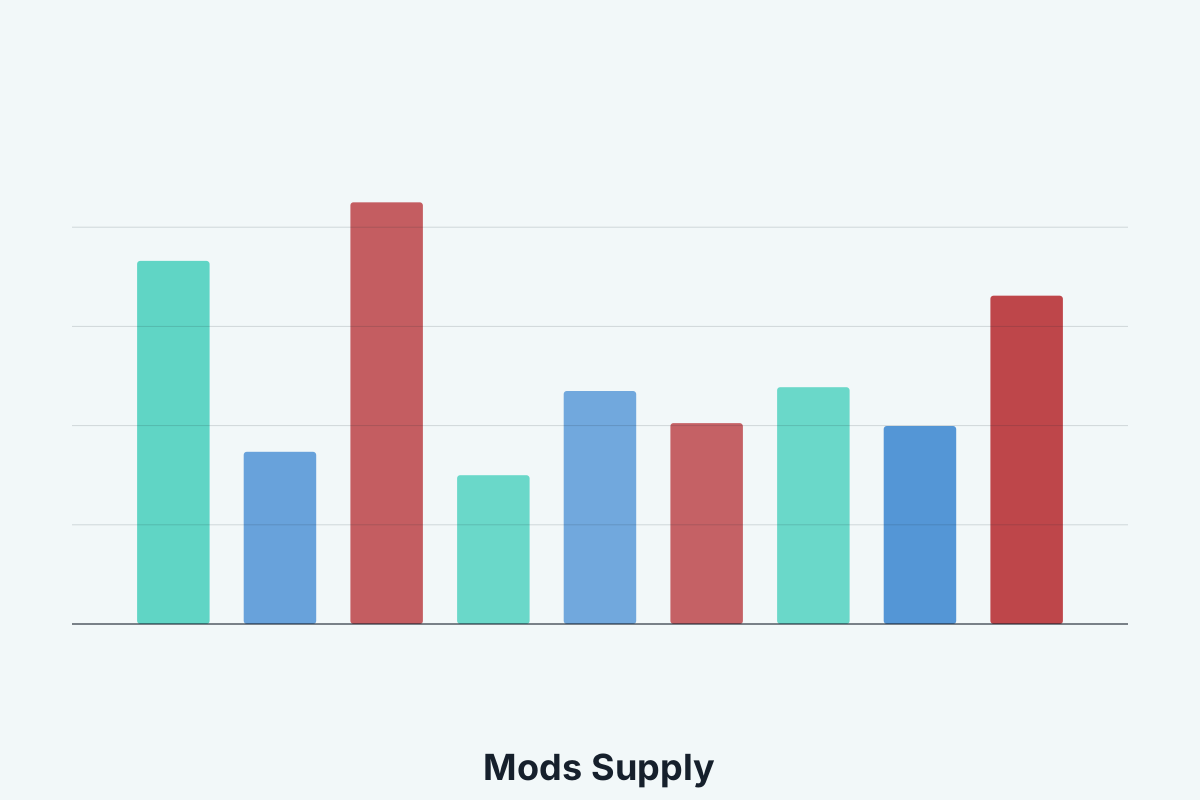
Demand for mods has been steadily rebalancing. The early phase rewarded whoever could ship fastest; the current phase rewards whoever can ship the same thing twice. That shift favours buyers who invest in specification rather than price shopping.
Where Mods Sits in the Range
Before anything else, decide which customer you are buying mods for. A convenience counter with limited shelf depth needs a tight range that turns quickly, while a specialist shop can carry a deeper ladder of options and educate buyers into higher ticket lines.
One useful exercise: list every mods line you stock and mark the last date each one sold at full price. Anything without a recent full price sale is taking space from something that would use it better.
Practical Checklist
- Plan the switch from air to sea freight before you need it.
- Rotate stock by batch code rather than by delivery date.
- Confirm the current customs classification with your own broker.
- Start with a mixed carton and let your own sell-through decide.
- Model landed cost, not ex-works price, when comparing quotes.
- Check carton dimensions against your freight quote before confirming.
Frequently Asked Questions
What if I only need a small first order?
That is normal and sensible. A mixed carton lets you test mods in your own market before committing to a production run, and the specification you approve at that stage carries through to larger orders unchanged.
What is the usual minimum order for mods?
For a standard production run the minimum is normally one master carton per flavour, though mixed cartons can be arranged for a first order. If you are testing the line, ask about a sample pack first and treat the freight as part of your research budget.
Do you hold stock for regular customers?
For established programmes we can reserve production slots and, in some cases, hold finished mods stock against a forecast. It removes most of the lead time risk from a reorder and is worth discussing once volumes are stable.
What happens if my market changes its rules?
Regulations move, and packaging or documentation sometimes has to follow. We keep approved artwork files on hand so that a required change is a reprint rather than a redesign, which keeps the cost and delay down.
How long does a mods order take to arrive?
Production typically takes ten to eighteen working days after artwork approval, and transit depends on the method you choose. Air express is fastest, sea freight is cheapest at volume. We confirm both at quotation so there is no surprise later.
Next Step
Whether you order from us or elsewhere, keep a retained sample from every batch. It costs almost nothing and it is the single most effective protection available to a mods buyer.
Related Reading
- Mods Handling Product Recalls Professionally — Three Price Tiers
- Mods Planogram Basics for Wall Displays — Freight Included
- Supplier Audit Checklist for Mods Orders — Latin America
- Mods Auditing Your Own Supply Chain — Tight Margin Categories
- Mods Tooling and Moulding Cost Structures — a Factory Floor View
- Mods Strengths Ladder for a Balanced Cabinet — Busy Buyers